School security has long focused on how to control visitor access. In recent years, schools have adopted more advanced access control measures, including pre-scheduled visits, visitor list management, and visitor pass issuance.
But one question remains.
Does verifying a visitor’s identity at the entrance mean that school security is sufficient?
This question is not just about operational inconvenience. It points to a structural limitation: many school security systems are still designed around an entrance-centric model.
Visit scheduling systems are effective for pre-verifying visitor identity and authorizing access. However, in actual school operations, that approval flow is not always connected to how visitors move through key access points after entry.
In other words, many school security systems manage visitors up to the point of entry, while the security flow after entry remains disconnected.
The Limits of Perimeter Security: Who Controls the Flow After Authorization?
On school premises, visitors come and go for a wide range of purposes, including parent conferences, guest lectures, facility inspections, deliveries, construction work, and event participation.
The problem is that many systems stop at classifying visitors as either “authorized” or “unauthorized.” At the entrance, the visitor’s identity and permission to enter the school are verified. After that, however, actual access beyond the entrance is often not managed in a connected way.
In this structure, it is more accurate to say that security is not absent, but disconnected in the middle.
Even when a visitor’s identity is verified, management gaps can still occur if the visit is not connected to its approved purpose, time, and permitted access scope.
Ultimately, the key to school security is not simply recording “who visited.”
It is about systematically managing who visited, when they visited, for what purpose, and how that approved flow is connected to actual access within the school.
<Visit Record-Based Management vs. Access-Linked School Security Operations>
| Category |
Visit Record-Based Management |
Access-Linked School Security Operations |
| Scheduling |
Manual or online submission |
Mobile reservation based on pre-verified identity |
| Approval |
Approval handled mainly by security staff |
Approval or rejection by the relevant teacher or staff member |
| On-site Authentication |
Manual check-in or printed visitor pass |
Visitor pass linked to verified identity information |
| Access Control |
Entrance-focused access control |
Integration with entrance and internal access control points |
| Record Management |
List-based record keeping |
Server-based storage, history lookup, and record export |
Why School Security Needs a ‘Zero Trust’ Perspective
In digital security, Zero Trust is already a familiar concept. Rather than granting full system access after a single login, this approach continuously verifies users, permissions, and access conditions.
Physical security in schools requires a similar perspective.
Checking a visitor at the main entrance and then allowing further movement without additional verification is not enough to ensure school security. In this context, Zero Trust does not mean over-controlling the entire school environment. Rather, it means designing a security structure in which visitor information verified at the entrance is connected to key access points inside the school.
When this perspective is applied to school operations, the core requirements become clear.
- Approved visitor information must match the actual person entering the school.
- Visit records must remain searchable and traceable.
- Administrators must be able to access relevant records when needed.
In a school environment, where various external visitors come and go and student safety is a top priority, a connected post-approval flow is a more practical security model than a one-time check at the entrance.
Strong Security Does Not Have to Mean Complicated Operationss
When schools consider introducing a new security system, the first concerns are usually similar.
“Will this create more work for the administrative office?”
“Will staff still have to check everything manually?”
“Will more systems simply make daily operations more complicated?”
These concerns are valid. In many cases, security systems increase operational fatigue by adding more checks, exceptions, and manual follow-up tasks instead of reducing the workload on site.
That is why the key issue is not simply whether security is strengthened, but how that security is implemented in daily operations.
School security should not create conflict between security and administration. Visitors should be able to make reservations and authenticate themselves as simply as possible. Administrators should only need to intervene when approval, exception handling, or record review is required. Records should also remain connected within a single flow, rather than being scattered across paper logs, separate files, or individual communications.
In this regard, a school-friendly security system should meet three conditions.
- Visit requests and authentication should be as simple as possible.
- Approved visitor information should be connected to actual key access flows.
- All records should be available for later verification, reporting, and tracking.
Ultimately, reducing operational burden while strengthening security depends less on the number of features and more on the connectivity of the overall architecture.
An Example of Connected School Security: VisitManager
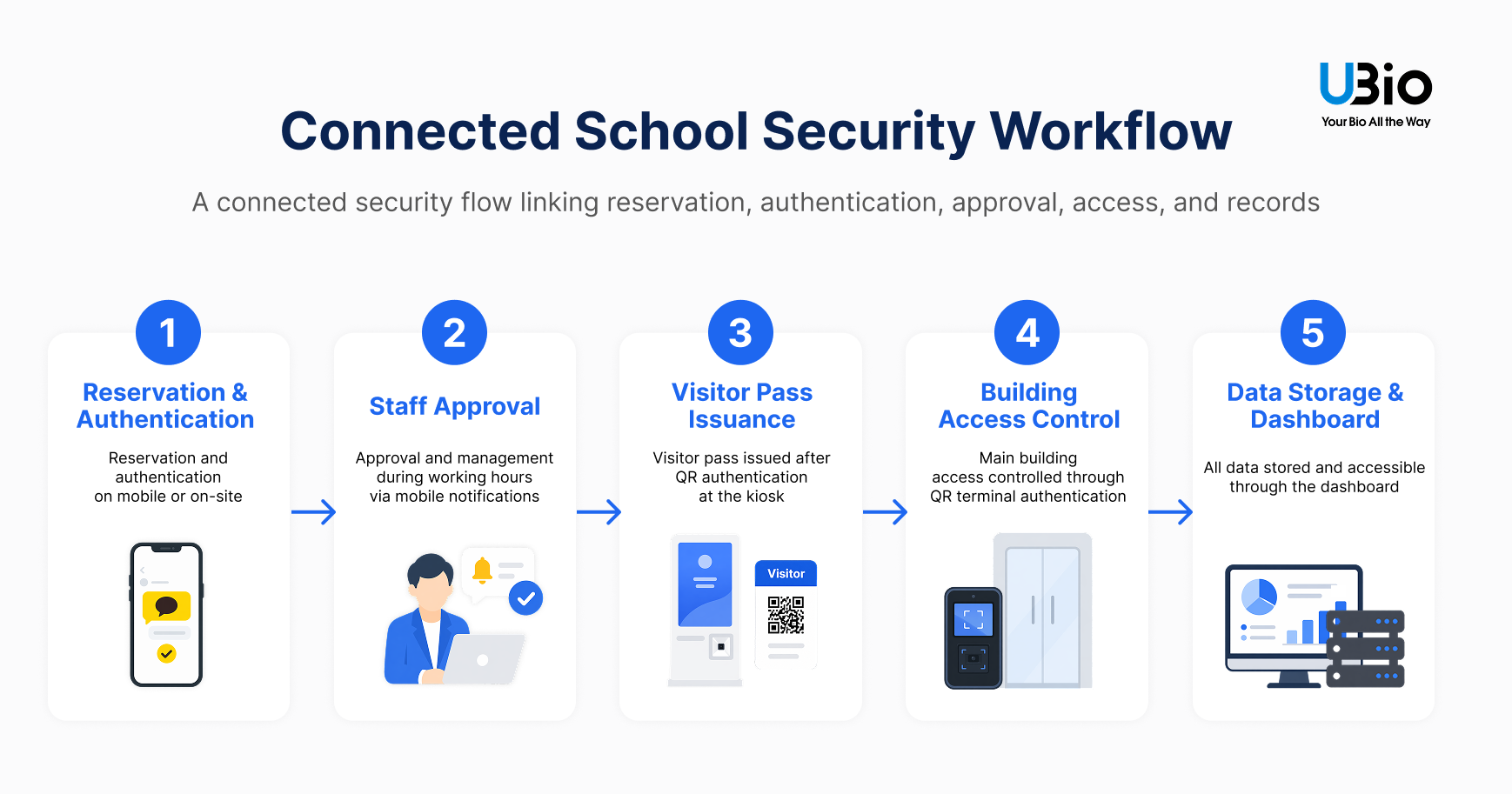
From this perspective, the next step in school security can be understood as a structure in which visit scheduling, on-site authentication, key access point integration, and record management are connected in a single flow.
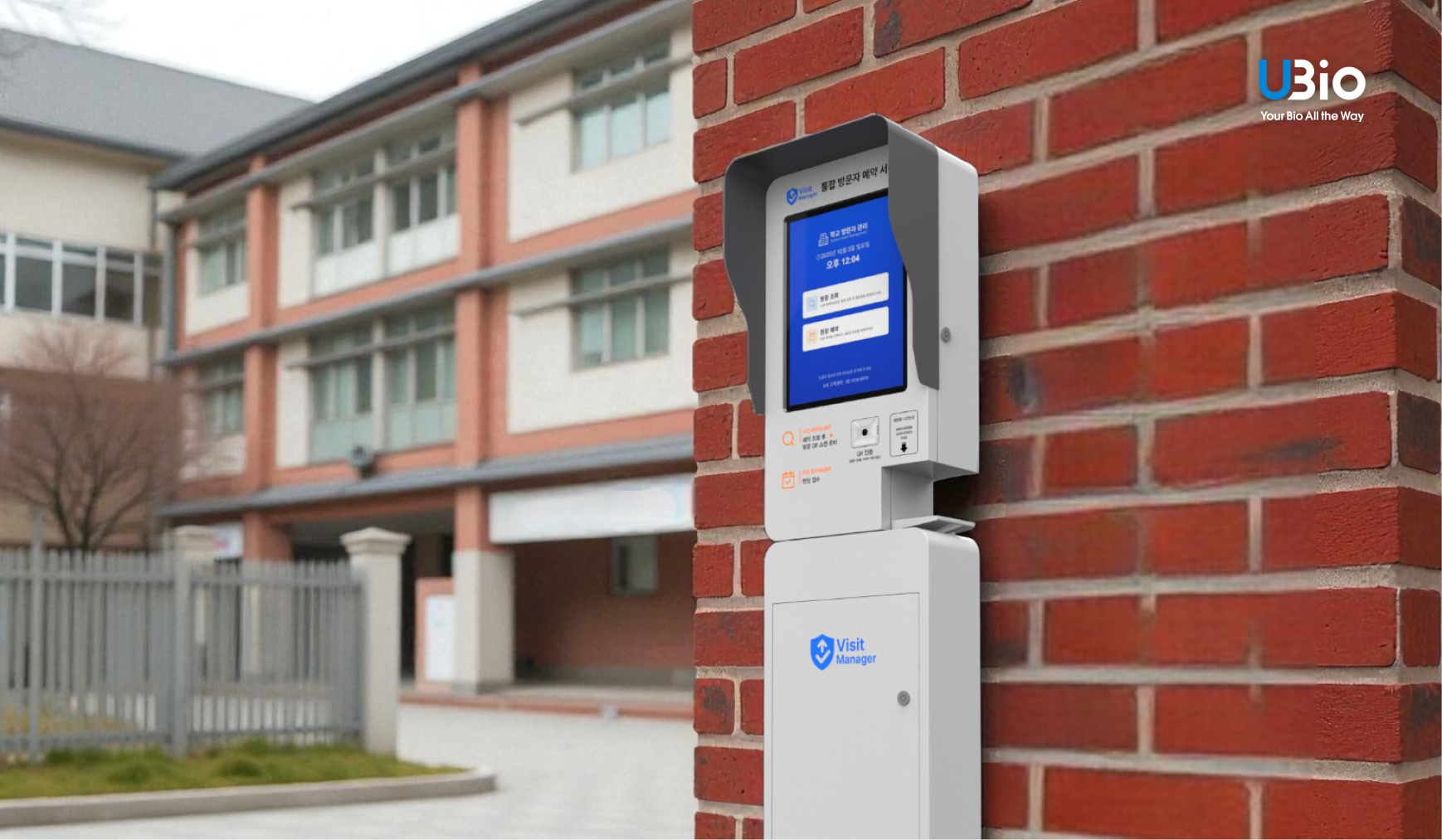
VisitManager can be viewed as one example of this connected operating model. Rather than managing visit scheduling, approval, on-site authentication, access control, and record lookup as separate functions, it is structured so that each step works together within a single operational flow.
For example, visitors can submit reservations through a mobile interface, while teachers or staff members can approve or reject visit requests. On site, authentication and visitor pass issuance can then take place based on the approved information. This flow can also be connected to authentication at key access points and record management, allowing schools to manage not only the list of approved visitors but also actual access activity and related records.
In other words, the value of this example is not simply in adding more functions. It is in connecting the operational structure of reservation, approval, authentication, access, and record management so that each step is not handled in isolation. In this respect, VisitManager offers a way to think about school security beyond an entrance-centric model.
School Security Does Not Stop at Approval
Schools must remain both open and safe. They cannot be completely closed off from the outside world, but they also cannot allow unrestricted access to everyone. For this reason, school security has always been a matter of balance, and that balance now needs to be designed more precisely.
The starting point is clear. Security should not end with checking a visitor once at the entrance. Instead, the approved visitor flow should be designed to continue naturally through key access points and record management.
School security should now be evaluated not only by whether visit applications have been digitized, but by how consistently approved visitor flows can be connected to actual access and record management.
In this sense, applying a Zero Trust perspective to school security is not about adopting another technology buzzword. It is about establishing an operational principle: visitor verification should not stop at the entrance, but should extend to key access points and record management.